

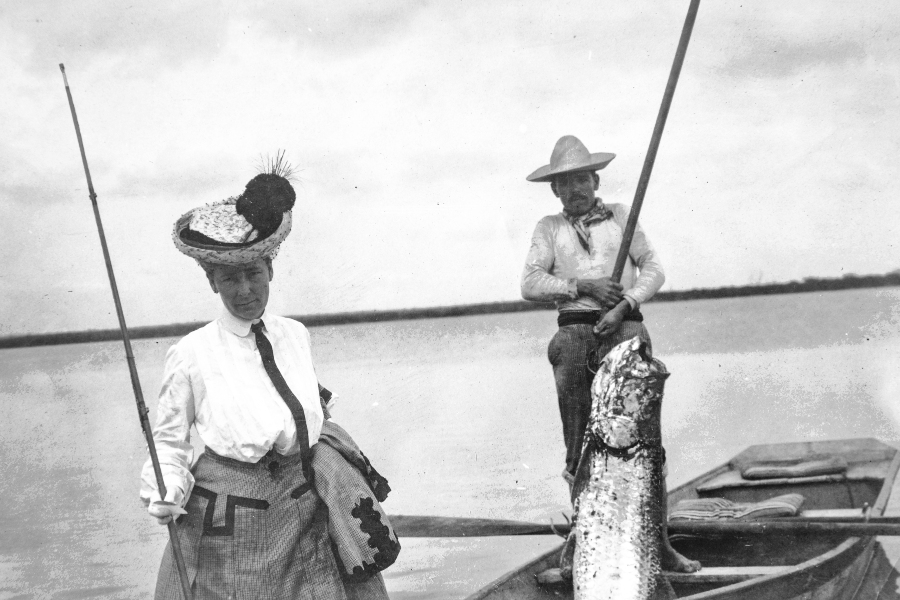
The desire of women, including NextTribe’s members, to travel adventurously with other women is a wish at least a century old. That joy was as real in the 1920s as it is today. I found it reflected in the writings of Rose Knox, the intrepid, widowed, self-possessed, highly successful female entrepreneur of the first half of the 20th Century.
From 1908 to 1947, Knox ran Knox Gelatine (yes, the one with the iconic orange box and gelatine molds). Knox built a #1 brand by accentuating her domesticity alongside her business prowess. She was one of the most famous businesswomen in America from 1915-1950, the year she died.
NextTribe creates small group travel experiences for women 45 and over. If you’re ready to stop waiting and start going, we’d love to have you along. Check out all our trips here.
Knox loved to travel by herself and believed in taking regular vacations, especially those that allowed a real escape. In the late 1920s, cruise travel offered those on shipboard the benefit of being completely out of touch with the world. On one cruise, everyone, encouraged by the crew, popped balloons at the Get-Together Dinner, she related.
Unconsciously we sometimes acquire more dignity than is becoming so we were advised to unburden ourselves that evening and told it would be perfectly proper to smile; and, if you felt like laughing, not to resist the impulse… that is, everybody was to talk to everybody and be good friends. The dining saloon was gayly trimmed, hundreds of ballons of all colors floating through the air – and the popping of them made great fun – even drowning out the orchestra at times.
Basking in Solitude
The boat provided its passengers with the kind of break that is exceedingly rare today given the ubiquitousness of cell phones and satellite internet. For Knox, once on a cruise, other than the news summaries received by the ship, which were slipped under her door every morning, her world was the boat, and the women she met there.
She looked forward to that. In Robert Wilder’s “On the Sun Deck,” column published on February 18, 1938, in the New York Sun, he told readers about Rose Knox:
It will be a long time, we think, before we encounter such a person as Mrs. Charles Knox aboard a ship. Mrs. Knox, by the way, is 80 years old and when we rapped on her stateroom door [before the ship sailed] and asked her for an interview, she threw a gown across one of the wardrobe trunks and said: “I won’t talk about politics. What I have to say might not look well in print.” …We learned that Mrs. Knox, for all her 80 years, turns up at her office every morning at 9 o’clock. She takes a vacation every year and hopes that: “No one…recognizes me for a week.”
Knox loved to travel by herself and believed in taking regular vacations, especially those that allowed a real escape
Once the liner steamed out of New York harbor, Rose Knox got her escape from responsibilities at business and home. As she told her son, “The life aboard ship is all so fascinating for me (although I never enter into much of it) … It is a good place in which to study human nature.”
Because Mrs. Knox was a wealthy and nationally acclaimed business leader, the captain would invite her to special private dinners with other luminaries held in his quarters. Otherwise, she joined regular meals and festivities in the large dining rooms or ballrooms on shipboard. And she reveled in the solitude: “the outstretched chair on deck, reading, sleeping and dreaming the hours away building air castles (even though they fall with a big thud, there’s fun building them).”
The Women’s Table?

Women traveling alone were generally placed at tables with other women as dinner companions. Only once in her many travels did Knox write about having to assert herself and ask to be re-seated when placed next to a “crank” while vacationing at the luxurious Homestead in Hot Springs, Virgina. That resort, which dated back to 1766, offered guests “sun baths,” prescribed by her doctor in an effort to alleviate her arthritis.
Being comfortable going solo on a cruise also meant going ashore for excursions in foreign lands. Knox welcomed these trips. She did not opt for the most luxurious or easiest itineraries. She maintained a bold, adventurous spirit–something most of us can relate to.
She did not opt for the most luxurious or easiest itineraries.
Her exploits included, at age 71, a five-mile camel ride in Egypt to visit the Pyramids and stand on Ramses II knee (before these monuments were protected from human touch).
Another excursion took her on an oxen-pulled sledge up and down the steep hills in Funchal, Madeira. First, she joined her fellow travelers on a cog-wheel railway that went up a 3,000-foot mountain. To return, she came straight down that very steep slope in a sledge guided by two men who ran alongside it and maneuvered it with ropes.
She could have joined the more timid of her companions who chose to travel on railcars instead of sledges or carts instead of camels in Egypt. But Knox knew what NextTribe travelers know – it is all about the experience!
Toughing It Out

On another occasion, while in Sicily, she showed how wrong stereotypes can be. The women in a group descended into catacombs in Palermo dating from the late 16th century, to see skulls, stacked six to eight deep on shelves. The men in the group, according to her report, “after taking one look, rushed from the place to the nearest café.” She went on: “The women of our party, having paid to see these relics of past history, remained to get their money’s worth.”
An intrepid traveler, she toughed out a narrow bed in Jerusalem that sloped enough to dump her on the floor. In Algiers she walked down wet, narrow cobblestone alleys, littered with onion peels and dead fish, where she said it felt like “the microbes were playing tag on you from head to toe.”
On another occasion, while in Sicily, she showed how wrong stereotypes can be.
Knox alternated her cruises with domestic travel, also by herself and usually via train. These more predictable trips allowed her to mix business and pleasure. She would spend a few weeks at spas in Colorado, Battle Creek, Michigan or Palm Beach, Florida and then meet with food brokers, grocers, and the media.
As a successful single woman and the rare female running a major national business in the male world of the 1920s and 1930s, Rose Knox appreciated her vacations. She applied to them what she showed in her business–resilience, courage, and the willingness to tackle anything. As she told her consumers. “Every woman can do more than she ever thought she could.”
Maybe that should be a motto for NextTribe travelers!








0 Comments