


Let your BFFs go to Paris again. If you’re in a “been there, done that” mood and ready to explore a place that’s very distant, very different, and very magical, Mongolia could be the right adventure for you. Especially if you’re the kind who likes being a pioneer; a little bit more curious and daring than most.
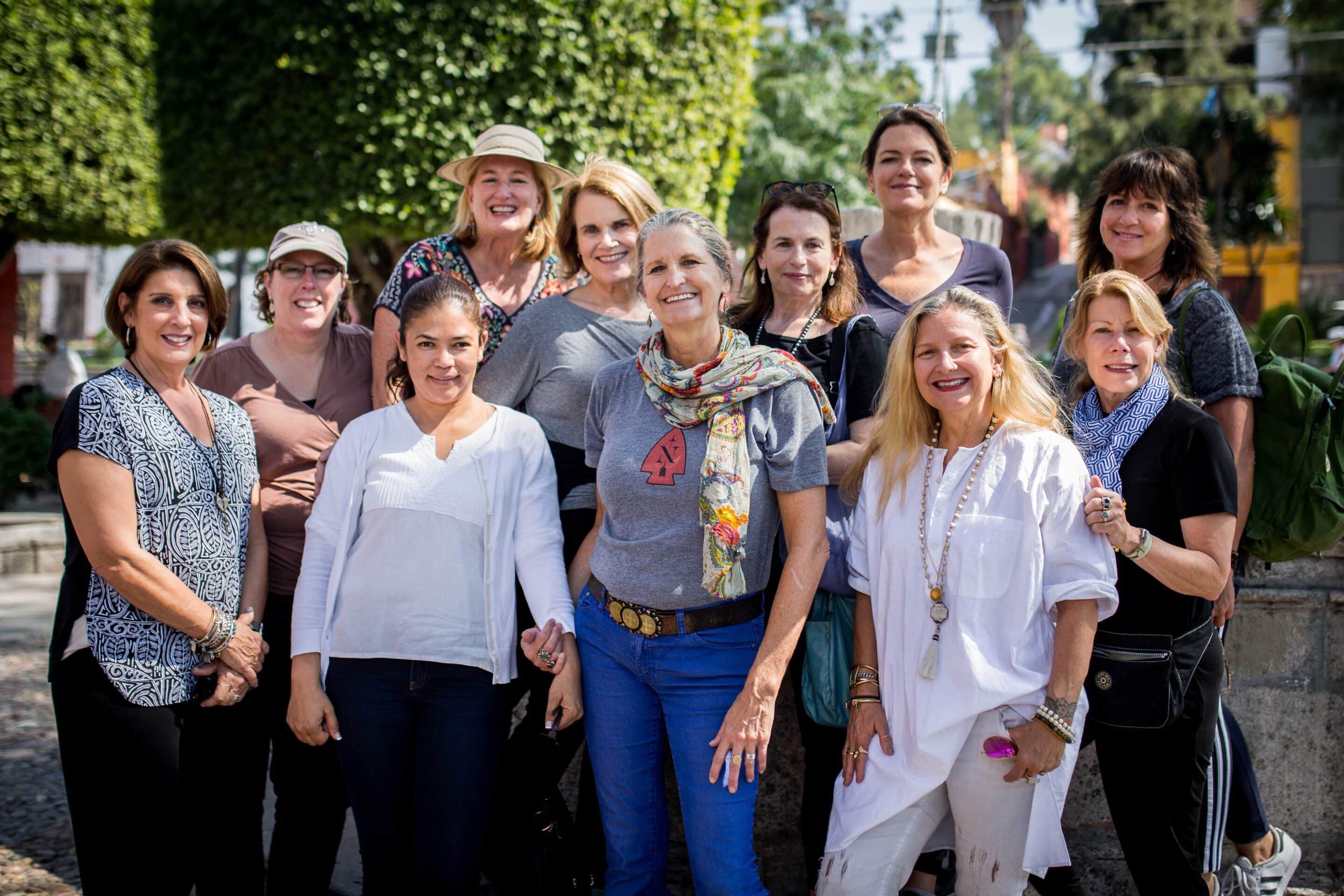
Join NextTribe in Mongolia over the summer of 2027! We’re taking a small group of women ages 45+ on a magical, carefully curated adventure there. Learn all the details here.
What to expect is the unexpected: expansive blue skies, ruggedly stunning terrain (think cliffs, mountains, and snow-dusted peaks), nomadic cultures, camels, gorgeous handcrafts, UNESCO World Heritage Sites, and lovely, welcoming people sharing tea with you.
If you are ready for a trip that opens you — mind, body, and soul — to a truly faraway part of the world and the people who live there, Mongolia could be the very place to visit next.
Get Your Bearings: Mongolia’s Geography and History
First things first: If you aren’t sure exactly where Mongolia is, let us fill you in: It sits between Russia (to the north) and China (to the South), and, size-wise, it’s about one-sixth the area of the U.S. In terms of landscapes, it’s almost surreally varied.
For a long stretch of time (say, 5,000 years), Mongolia was primarily distinguished by its nomadic lifestyle. Clans lived in its challenging but jaw-dropping terrain, traveling, setting up homes, and moving again as they followed food, water, and the seasons. (Some local families still follow this time-honored rhythm, quite a different way of life than Americans know today.)
Then, in the early 13th century, one man had a profound effect, uniting fractious Mongol tribes. In other words, enter Genghis Khan, who built a huge empire that, at its apex, spanned from South Korea to Eastern Europe. His grandson, Kublai Khan, founded the Yuan Dynasty in China. For some time, the Mongol Empire was a critical link between the East and the West, and it established trade routes that reshaped the world.
The landscape is so diverse. You’ll experience river valleys, sand dunes, and green rolling and forest steppe.
When this empire broke apart, Mongolia was the scene of several centuries of shifting rule, with China having control for long chunks of time. Eventually–1921 to be precise–Mongolia declared its independence (aided by the Soviet Union), and it stood as a communist country for almost 70 years. During this period, monasteries were closed, and Buddhist leaders were persecuted. The nomadic lifestyle, a cornerstone of Mongolian life, was discouraged.
Fast-forward to 1990, though, for another major transition. Mongolia peacefully shifted to a democracy and flourished. The monasteries reopened, nomadic families adopted their traditional lifestyle again, and a once-isolated country began welcoming outsiders. Now home to 3.5 million people (about half of whom live a somewhat or fully nomadic life), Mongolia offers a rare glimpse of unique cultures and juxtapositions, from people checking their social media amid the cafes and apartment towers in Ulaanbaatar (also written Ulan Bator), its capital, to sacred Buddhist sites and traditional ger camps (circular, felt-covered tent communities) that continue an ancient rhythm of nomadic life.
“The landscape is so diverse. You’ll experience river valleys, sand dunes, and green rolling and forest steppe,” says Jess Brooks, NextTribe’s local expert who has extensive connections with local families. Her company is dedicated to training women to work in hospitality and improve their prospects.
Weather in Mongolia — and When to Go

Mongolia is a country of extremes, and that includes its weather. Winters can be brutal, so your best bet is to avoid that time of year and other stretches of cool weather (which can include early spring) and instead focus on summer.
Traveling in summer also means you’ll likely cross paths with nomadic families during their most active season.
The best time to visit is late May through early September, with the sweet spot being July and August (which is exactly when NextTribe leads its guided tour of Mongolia). During these months, the steppe (the dry, flat grassland with very few trees) turns an inviting deep green, wildflowers sway along the hillsides, and daytime temperatures settle into a delightfully comfortable range from the 70s to low 80s. What’s more, you’ll get to revel in endless blue skies and sunshine (Mongolia averages an extraordinary 250 or more clear days a year). Just know that evenings can be cool, so pack layers and perhaps a warm hat to take the edge off any chilly evenings.
Traveling to Mongolia in July carries an extra reward: the Naadam Festival, Mongolia’s biggest cultural celebration, held nationwide and centered in Ulaanbaatar. Naadam showcases wrestling, archery, and horse racing — traditions central to Mongolian identity. Even outside the capital, smaller countryside Naadam celebrations pop up throughout summer, offering a fascinating glimpse into local customs.
Traveling in summer also means you’ll likely cross paths with nomadic families during their most active season, as they move from pasture to pasture with their herd. This makes for an opportunity to be welcomed to authentic gers for tea, conversation, and cross-cultural sharing.
Mongolia: How to Get There
Yes, the mere mention of Mongolia can conjure up a super-remote place that is barely accessible to travelers. Admittedly, direct flights from the U.S. are typically not available, but getting to Chinggis Khaan International Airport (UBN) in Ulaanbaatar is similar to how you’d travel to other destinations in Asia. You typically connect through hubs like Seoul, Beijing, Tokyo, Hong Kong or Istanbul, with your total travel time from the States totaling 16 to 20 hours door-to-door, including your flight connection. And it’s worth it.
A bit of nice news: U.S. citizens do not need a visa for short tourist stays in Mongolia, which removes some pre-trip paperwork that many other far-flung destinations require. As with any international trip, especially those to remote areas, travel insurance and other related protections, can be a smart move.
Because Mongolia is enormous — roughly the size of Alaska, with a fraction of the infrastructure — how you move around the country once you land matters enormously. NextTribe’s trip focuses on exploring Mongolia’s historic central heartland by vehicle, eliminating domestic flights altogether and turning travel time into part of the experience — moving along steppe roads, stopping for photos of eagles overhead, and watching the landscape shift from forest to dune.
Where to Go: Visiting Mongolia’s Must-See Attractions
When you get to the other side of the world, here are favorite places that allow you to soak in the glorious scenery and culture in a relatively short period of time:
Ulaanbaatar: Where Old and New Collide
Nearly every journey begins in Ulaanbaatar (UB to locals), a city that defies easy categorization. Wander through Sükhbaatar Square, the city’s grand central plaza, or duck into the Gandantegchinlen Monastery, one of the country’s most important Buddhist sites, where monks still chant beneath a towering gilded statue of Avalokiteshvara. The Chinggis Khaan National Museum offers an engrossing introduction to Mongolian history, from ancient nomadic culture through the empire and into the Soviet era. It’s an excellent way to get oriented before heading into the countryside.
The capital city UB is also where you’ll find the country’s best cashmere shops (perfect for filling your suitcase with souvenirs), art galleries, and café culture, a fitting taste of modern Mongolian urban life before the wilderness that follows. It’s also where you’re least likely to encounter a language barrier, as increasingly, city dwellers, especially younger generations, may speak English. Once out of the capital, your guide will likely do the translating for you.
Khogno Khan: Sacred Mountains and Surprise Dunes

A few hours outside the capital, the landscape begins to shift dramatically. Khogno Khan Mountain, considered sacred by Mongolians, rises in dramatic granite formations above the Mongol Els sand dunes — a stretch of golden dunes that seem entirely out of place amid the surrounding grassland and are all the more magical for it. It’s prime territory for photos, and it also offers your first taste of camel country. It could also be your first night falling asleep in a ger, the traditional tents, under an enormous, star-scattered sky, far from any city lights.
Camel Country and Local Herders
Out in the steppe, though, there’s more to do than just be awed and snap photos. For instance: How about riding a two-humped camel? No special skills are needed for this gentle activity, and spending time with the local herding families who raise these camels — sharing tea, watching daily chores unfold, understanding how an entire household can pack up and relocate in an afternoon — offers a level of access into nomadic life that few travelers ever get. Talk about memorable experiences: This isn’t a historical reenactment or a demonstration staged for tourists. It’s simply how life flows in this part of the world, and you’re being welcomed into it.
Tsenkher Hot Springs: The Reward

After days of long, scenic drives and steppe adventures, the Tsenkher Hot Springs, sheltered by a wooded pocket of the Khangai range, can be a welcome moment to kick back and enjoy some selfcare plus pristine nature. The area’s thermal waters are piped directly from the source into outdoor soaking pools at ger camps here, leading to a peak travel moment; a reward for venturing so far from home. Imagine easing into warm mineral water while watching birds of prey drift overhead and the evening light creep in, shrouding the hills in darkness.
It’s such a lovely way to decompress when traveling, to be in these charming hot-spring pools, surrounded by the mountains.
Our NextTribe trip builds in enough time to truly relax and enjoy this blissful spot rather than simply passing through.
Tsetserleg and the Khangai Mountains
Further west, the pace slows further in Tsetserleg, a relaxed storybook town that’s framed by forested hills. Continue westward, and you’re venturing into the Khangai Mountains, one of Mongolia’s oldest and most ecologically important ranges. Here, yaks graze on hillsides, eagles circle overhead, and the population thins to just herders, their livestock, and the occasional wolf keeping a respectful distance. This region is also home to Przewalski’s horses — known locally as Takhi — the last truly wild breed on earth, once extinct in the wild and painstakingly reintroduced to Mongolia’s protected grasslands. Spotting a herd of Takhi grazing freely qualifies as a next-level wildlife privilege, right up there with seeing rhinos on an African safari.
Kharkhorin and the Orkhon Valley: Empire and Sacred Ground

No trip to Mongolia’s heartland is complete without Kharkhorin, site of the ancient capital Karakorum, founded by Genghis Khan himself in the 13th century and once the political center of the largest empire in history. Little remains of the original city above ground, but the nearby Erdene Zuu Monastery — Mongolia’s oldest surviving Buddhist monastery, built in the 16th century partly from the stones of ancient Karakorum — is a stunning, walled complex of temples, stupas, and courtyards that survived Stalinist-era purges largely intact. While it may not technically be a so-called “wonder of the world,” you may want to argue with that once you visit.
Just beyond lies the Orkhon Valley, a UNESCO World Heritage cultural landscape recognized for its unbroken record of nomadic pastoral tradition stretching back for millennia. Wandering this valley, with its rivers, waterfalls, and grazing herds, is as close as most travelers will come to seeing what this land looked like when it shaped the course of world history and was part of a sprawling empire.
Other Best Things to See in Mongolia
If you have time to travel further from this central region, other top attractions in Mongolia include:
- The iconic Gobi Desert, close to the border with northern China
- Altai Tavan Bogd National Park, the high peaks of western Mongolia where Kazakh eagle hunters rule
- Gorkhi-Terelj National Park, with its dramatic granite rock formations
- Bayanzag (The Flaming Cliffs), with rust-colored sandstone cliffs famous for world-class dinosaur fossil discoveries
- Lake Khövsgöl, aka the “Blue Pearl of Mongolia,” an alpine freshwater lake near the Russian border
Food, Drink, and Culture: What to Savor

Most travelers are probably wondering: What on earth will I eat and drink in this remote location? And what are the people and the culture like?
Wonders await on all counts. Mongolian cuisine is hearty, simple, and deeply tied to a nomadic, pastoral way of life — this is food built to fuel people who move constantly and endure extreme weather. And that’s part of its charm: Every dish tells you something about how people here actually live and may even shed light on how all of our ancestors once ate.
Meat and dairy form the backbone of the traditional diet.
* Buuz — steamed dumplings filled with mutton or beef and onion — are pretty much the national comfort food and are available nearly everywhere, year-round.
* Khuushuur, a fried, meat-filled pastry, is Naadam Festival’s unofficial snack of choice.
* Khorkhog, a celebratory dish of meat slow-cooked with hot stones in a sealed milk canister, is often prepared for special occasions or in honor of visiting guests — if you’re lucky enough to be offered it, you’re being treated as family, not a tourist.
If this is sounding like more meat than you are accustomed to eating, vegetarian food can also be found. Your tour operator can likely order it in advance for you as well. Try Budaatai Khuurga/Baitsatai Khuurga, fried rice or fried cabbage dishes mixed with root vegetables like carrots and potatoes.

Also know that many of the traditional dishes can be made with potatoes, cabbage, carrots, onions, and mushrooms instead of meat to accommodate different dietary preferences and needs. What you likely won’t find much of: seafood. Mongolia is a landlocked country, so fish and shellfish are rare and quite expensive.
Dairy, in all its forms, is central to Mongolian life and cuisine, a legacy of a culture built around livestock. You’ll likely be offered suutei tsai, a salty milk tea that’s as much a gesture of hospitality as it is a beverage, along with an array of dried curds, clotted cream, and yogurt made from cow, yak, sheep, or even camel milk. Go ahead, have a taste: How often in life do you get to try a food you’ve likely never had before and may never try again.
And then there’s airag — fermented mare’s milk, slightly alcoholic, tangy, and something of a rite of passage for visitors. It’s an acquired taste, but trying it is less about the flavor and more about the moment: sharing a bowl with a herding family in their ger is one of those small acts of connection that tends to stay with you long after you’ve gone home.
Take note: Traditional etiquette around entering a ger, accepting food and drink with your right hand (or both hands), and passing items runs deep, and locals are generally warm and patient with visitors who make a genuine effort. Music plays an enormous role too, particularly throat singing (khöömii), a haunting vocal technique that allows a single singer to produce multiple pitches simultaneously, and the morin khuur, or horsehead fiddle, Mongolia’s national instrument, which sends haunting melodies into the air.
And let us not forget the traditional gers themselves — the round, felt-covered tents that have housed Mongolian families for centuries and remain a genuinely comfortable, ingenious piece of architecture. Insulated, easy to assemble and disassemble, warmed by a central wood-burning stove, and arranged according to long-held customs (certain sides for men, women, guests, and the household altar), a ger isn’t roughing it so much as it is stepping into a completely different way of living. It can be an unforgettable way to experience a lifestyle that’s been thriving for thousands of years, thousands of miles from your home.
Why Mongolia Now, and Why With the Right Group?

Mongolia rewards travelers who come with curiosity rather than a checklist — and it’s precisely the kind of place that’s better experienced with the right companions and a guide who has real relationships with the families and communities you’ll meet along the way. Access to nomadic life, hot springs shared with new friends instead of strangers, a camel ride that turns into an inside joke for the rest of the trip — this is a country that opens up when you’re navigating it with the right leader and companions.
Mongolia shows you a pristine environment that has been relatively untouched by our idea of modern life. You’ll experience things you’ll never experience anywhere else.
You’ll see sacred spaces, stunning landscapes, wild creatures, ancient sights, and nomadic traditions that are 5,000 years in the making, for sure. But beyond that, you’ll find a new version of yourself, experiencing an area that’s been undiscovered by too many for far too long. Why not be a pioneer, and dive into all it has to offer? Mongolia offers a waking dream; memory-making at its finest.







0 Comments