


I knew about palm readers, tea-leaf readers and face readers. Until I went to Oaxaca with NextTribe last month, I didn’t know there were egg readers.
In the Zapotec healing tradition, a curandera—a healer and spiritual guide—passes a raw egg over your body to draw out its energy. Then she cracks the egg into a glass of water and reads the shapes the whites make. In my glass, a single long strand stretched from the surface to the bottom. That, she told me, signals a deep connection to, and worry about, someone close in the family.
She got that right. What mother doesn’t worry about her child? (Her only child, in my case.)
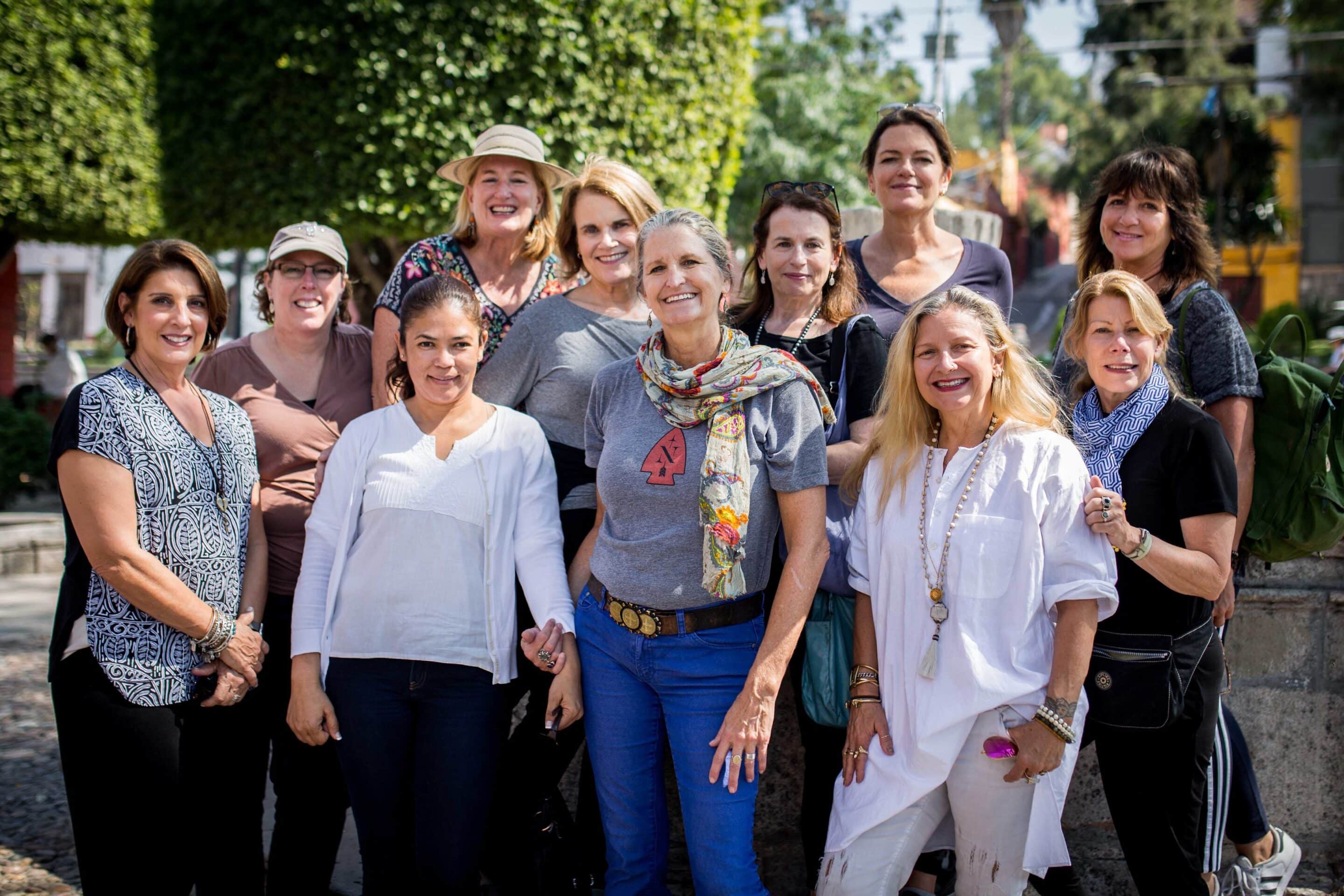
NextTribe takes small groups of women ages 45+ on fun, transformational trips. We are returning to Oaxaca in August 2027 and invite you to come along. Learn more here.
The reading took place in the Sierra Norte, the mountains north of Oaxaca City. Afterward, some of the women in our group said they felt seen and understood in a way they hadn’t expected. Others simply felt calm. I felt a little high: bare feet grounded on the dirt floor, the rest of me as light as a sheer curtain in a breeze.
That’s when I understood these eight days would be more than a trip. They’d be a journey–into myself and into the lives and traditions of this land of Mixtecs and Zapotecs and other ancient people. In Oaxaca, Indigenous rituals still shape daily life, and it’s largely women who keep them alive, handing them down from grandmother to mother to daughter. We spent our time with those women—healers, artisans, chefs, business owners—and for a little while, they let us sit at their table.
The House of Heat
One of our most interesting rituals was the temazcal, a traditional sweat lodge. The name comes from Nahuatl, the language of the Mexica (Aztec empire), and means roughly “house of heat.”
Before we went in, the curandera purified us with smoke from copal, a tree resin, burning in a clay vessel called a sahumador. She swept the smoke up, down and all around our (clothed) bodies. Then she handed each of us a bundle of herbs and branches to hold against our hearts while we set an intention for the ceremony.
The door closed, and the drumming and chanting began.
She showed us the “grandmother rocks,” which had been heating in an open fire for hours. A burly man lifted three of them, glowing red, with a hay rake and carried them inside, setting them gently in the pit at the center of the lodge. Once he left, we undressed—some of us completely, some down to swimsuits—and crawled through the low opening on hands and knees, like infants. Entering this way is said to represent returning to the womb to be reborn.
The door closed, and the drumming and chanting began. It was mesmerizing, and for some of us it brought a deep stillness that is hard to describe. Just know that it’s pitch black, everyone sweats, and no one left before it was over.
We slept very well that night.
A Silent Climb

The Sierra Norte was the spiritual heart of the trip. In Capulálpam de Méndez, we visited Manos que Curan (Hands That Heal), a clinic that combines traditional and holistic medicine. It treats local residents and hosts healers from elsewhere in Mexico and abroad for longer stays. More than one of us wished we could have signed on for another week or two.
Nearby, local women and a Zapotec spiritual leader led us on a gentle hike to the top of Mount Jaguar, a place so sacred we were asked to walk in silence.
Nearby, local women and a Zapotec spiritual leader led us on a gentle hike to the top of Mount Jaguar, a place so sacred we were asked to walk in silence. We stopped whenever it felt right—to take in a view, feel the breeze, smell the flowers, record a birdsong.
On a grassy plateau, we did a trust exercise and then stood around a medicine wheel as our guide called in the ancestors from the four directions. Each of us left a small gift on the altar—a stone, a flower—before we walked back down the mountain together.
The Women Who Keep the Traditions

The spirituality we encountered wasn’t confined to ceremonies. It ran through the work of the women we met.
At Vida Nueva, a weaving cooperative, women make tapetes—rugs, blankets and bags—working side by side while their children play nearby. Other cooperatives we visited teach skills to single mothers and survivors of domestic violence. Buying directly from these artisans means they got to keep most, if not all, of what you spend there. A purchase is less a souvenir than an investment in a woman and her family.
The spirituality we encountered wasn’t confined to ceremonies. It ran through the work of the women we met.
Then there’s mezcal. We visited a palenque, where agave is grown and distilled, and had lunch with its owner, a woman who has made her name in a famously macho industry. She learned the craft from her father and grandfather, but she still had to prove herself as a distiller, a businesswoman and a boss.
“Sometimes I have to be gentle,” she told us, “but sometimes I have to show them I’m in charge.”
Her success rests on staying true to her family’s traditional methods, and her brand’s tagline says it all: “Porque sólo lo auténtico perdura”—because only authenticity endures.
Feeding the Body, Too

Not every moment was meditative. We explored the archaeological sites of Mitla and Monte Albán. At Hierve el Agua, some of us soaked in the mineral pools while others climbed the petrified waterfall, a cliff of mineral deposits that looks like water frozen mid-fall. It wasn’t easy, but everyone made it, including a few women in their 70s.
And we ate, from morning to night. Yes, chapulines (toasted grasshoppers) were on the menu. So was cooking by Michelin-recognized chefs, in restaurants where the food lived up to the beautiful plates.
Gratitude

On our last evening, back in Oaxaca City, curanderas came in from another village to lead us in a final ceremony of gratitude. One of them moved around the circle, blowing a conch shell toward each of our hearts. Someone in the group caught the moment on camera (see photo at the top of the page.)
A trip like this doesn’t end when you fly home.
At the end, we took off our shoes and stood on the branches that had been used in our spiritual cleansing. The curanderas gathered them into a basket to take home and spread on their land, so that a little of each of our spirits and energy would become part of the soil there.
How’s that for a journey?
The Journey Continues
A trip like this doesn’t end when you fly home. One woman from our group is going back in October to build houses with a local nonprofit. Another will lead this same journey in 2027. And I’m planning my own return before the year is out.
San Miguel de Allende may get the press and the glory. But if you’re looking for a journey, not just a trip, look to Oaxaca—and to the women who keep its old ways alive.







0 Comments