

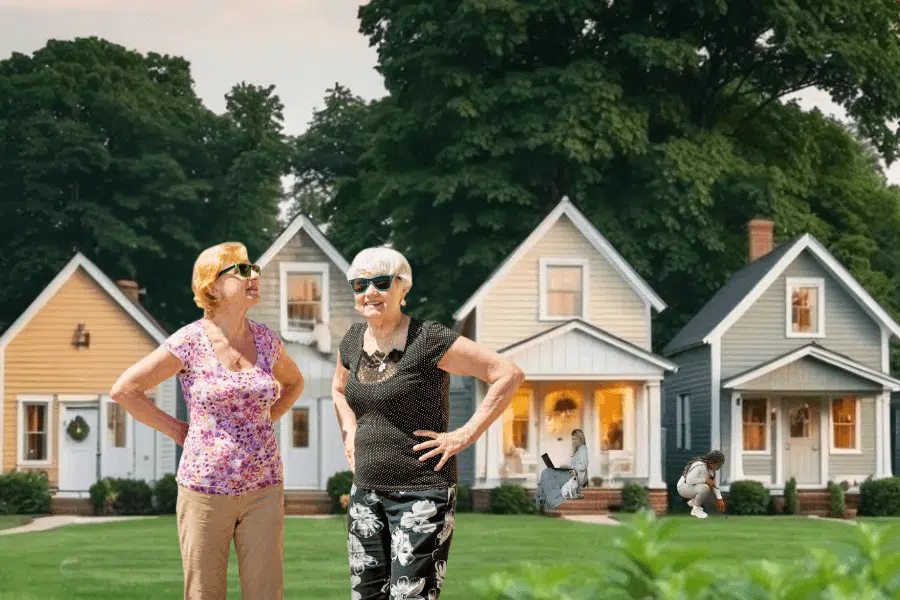
- Women-only cohousing communities are a growing trend among midlife and senior women, exemplified by communities like the Bird’s Nest in East Texas.
- Financial and social factors are driving the trend: Nearly half of women 65+ are single, and social isolation remains a pressing problem among older people.
- NextTribe Living plans to launch a women’s cohousing community in Western North Carolina, founded by NextTribe CEO Jeannie Ralston.
If you enjoy traveling with friends, imagine what it would be like to have your besties as neighbors. Sound good? No wonder more women are embracing shared living!
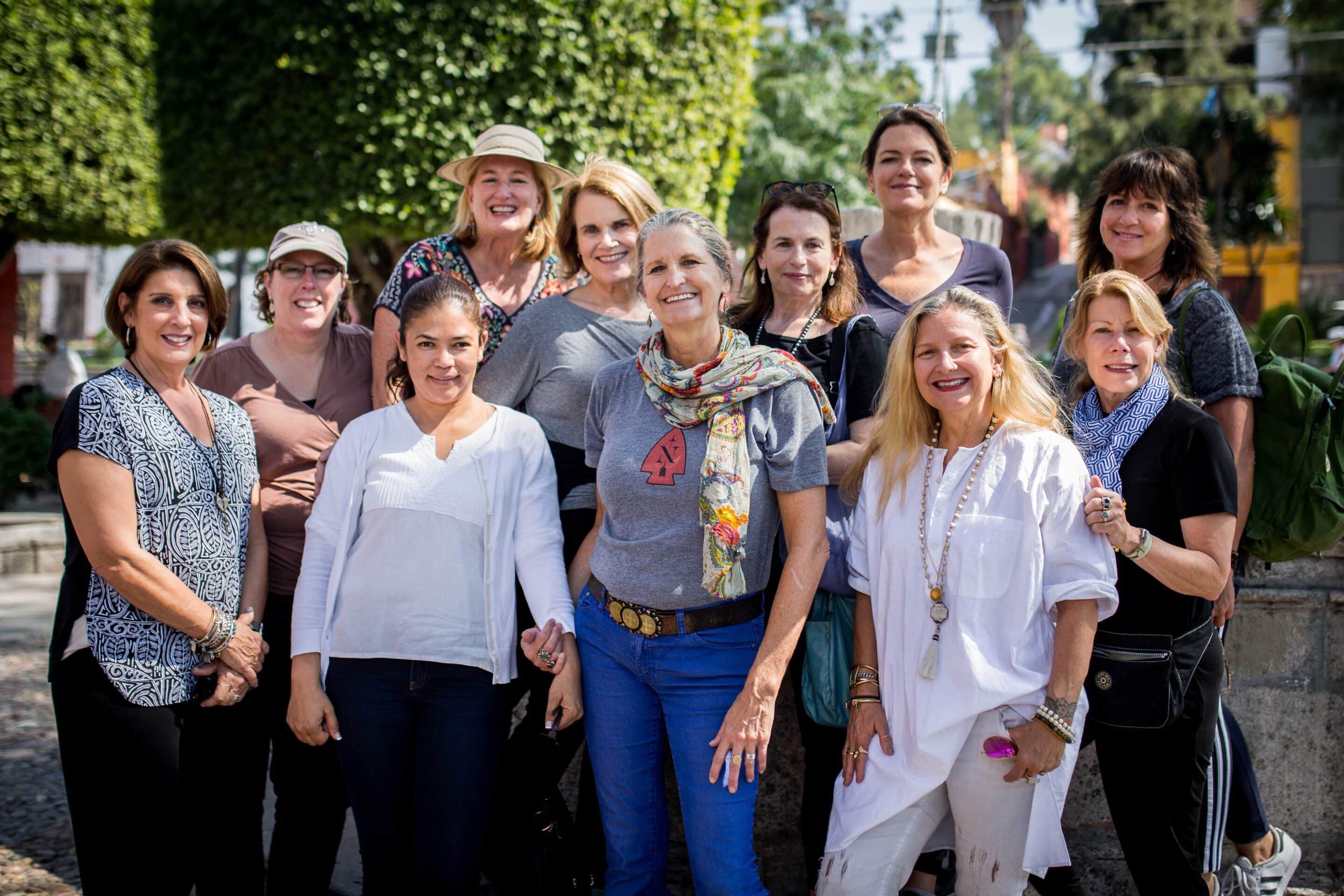
When Cheryl Huff towed her tiny home to her pal Robyn Yerian’s East Texas plot a few years ago, they both figured it would be a boon to their existing friendship. They never expected the situation to evolve into a cohousing community—but that’s exactly what happened. Now the Bird’s Nest, as it’s called, has 11 residents, all women ranging in age between their 60s and 80s.
The Bird’s Nest may seem unique, yet cohousing—intentional, collaborative neighborhoods that combine private homes with shared indoor and outdoor spaces for social activities—is actually a rising trend in real estate. There are approximately 250 cohousing communities in the U.S.; some are multigenerational (open to all ages and genders), others are just for seniors, and a growing number are for women only.
If you’re interested in learning more about NextTribe’s plan for a women’s only community, please fill out this questionnaire here.
At the Bird’s Nest, the primary objective is to age in place, living independently; the bonus is how the residents nurture strong social bonds. “I never saw these people before in my life, and now I can’t imagine them not being here every day,” Yerian told the New York Times. As to the “no boys allowed” rule? Chalk it up to a desire to maintain autonomy and avoid mansplaining. As Yerian put it on the Bird’s Nest website: “There’s no ‘You’re doing it wrong’ here.”
A Golden Opportunity
Perhaps the greatest inspiration for female shared living is The Golden Girls—the hit ‘80s-era TV show that made Blanche, Rose, Dorothy, and Sophia literally household names. Yet while the sitcom was warm and fuzzy, some cold, hard realities make cohousing attractive to midlife and senior women today.
For one thing, a lot of us are single. Nearly half of women 65+ in the U.S. are unattached, according to the Pew Research Center, and about three in 10 between 50 and 64 also go solo.
Which is actually okay! Pew discovered that 71 percent of single women over 40 aren’t looking for a relationship. Separate research by The Senior List found that a whopping 87 percent of singles 50+ say they’ve found happiness without romance.
27 percent of women ages 65 to 74 live alone, and after age 75 that number reaches 43 percent.
But just because you’re not coupled-up doesn’t mean you’re antisocial. Indeed, solid friendships are crucial in midlife. The mortality impact of social disconnection may be equivalent to smoking 15 cigarettes a day, with social isolation particularly problematic among older adults, causing an estimated $6.7 billion in excess Medicare spending annually.
Single women also often face more financial concerns than single men. According to AARP research, 64 percent of unmarried working women 50 to 64 have less than $50,000 in retirement savings. And on average, women’s Social Security benefits are about 80 percent of what men receive.
Cohousing can save residents money through sharing expenses on utilities, transportation, services, contractors, and big-ticket purchases like a grill or hot tub. Some cohousers even report that their busy social calendar means less time alone online, resulting in fewer pricey impulse purchases.
And yet, recent U.S. Census figures show that 27 percent of women ages 65 to 74 live alone, and after age 75 that number reaches 43 percent. Clearly, the time for cohousing has come!
A Warm Welcome for Women

Some all-female shared living villages evolve organically, but their increasing popularity is attracting a variety of business professionals. Consider the Santa Fe, New Mexico, community being built by hospitality honcho Chip Conley, a former Airbnb exec now the CEO of Modern Elder Academy.
It’s certainly a natural arena for NextTribe CEO Jeannie Ralston, who hopes to bring the same “Aging Boldly!” ethos to cohousing that she has to the digital community and travel company she founded in 2017. “I got the idea from our members!” Ralston freely admits. “Women often tell me how much they love the friends they made on our trips—and that they could be happy living their next stage surrounded by the same type of women.”
A cohousing community seems like a logical extension.
Over the years, Ralston has witnessed how engaged, open-minded midlife women can bond, offering each other support and grace. “We create communities on every trip, and that has led to NextTribe communities in 10 different American cities, where women get together outside of travel,” she says. “So in a sense, a cohousing community seems like a logical extension.” At the moment, Ralston is researching properties, meeting with investors, and getting all-important feedback from NextTribers (often via the “Golden Girls Living” channel on What’s App).
Ralston hopes to launch NextTribe Living in Western North Carolina. “It has four seasons, all wonderful to experience in the Blue Ridge Mountains,” says Ralston, who happens to live in the Asheville area herself. “There’s a great mix of cultural activities and natural beauty, and a thriving scene of restaurants, breweries, museums and music.”
She envisions a community of four to seven homes to start. “That will depend on the size of the property and zoning,” Ralston points out, adding optimistically, “If the first community proves a success, we may branch out to other cities, specifically those that already have NextTribe communities.” Her ideals for NextTribe Living in a nutshell: “Support without surveillance. Independence with backup. Engagement without obligation.”
Read More: My Retirement Fantasy Is a Beach House with Girlfriends
Choosing a Cohousing Community

Anyone who grew up spatting with sisters or rolled her eyes over roommates in her youth knows that living with women isn’t necessarily paradise. Fortunately, in most cohousing setups, residents have their own homes, so there’s no chance of a neatnik contending with a slob in a shared bath or a minimalist enduring fussy decor in the living room.
Still, choosing a cohousing community is a big decision. Here are some things to consider:
Location, location, location
It’s the major maxim of real estate for a reason. Suss out cohousing in an area that truly suits your lifestyle. If you’re done with cold weather, search in the south. If scenic splendor is important, find a spot in the mountains or by the beach. If you want intellectual stimulation, consider a college town or a place with easy access to a cosmopolitan city.
Perhaps your most important consideration is who your cohousers will be.
Size matters
Although Carefree, a women-only resort-style development in North Fort Myers, Florida, has 278 homes and RV spots, cohousing communities tend to be much smaller, typically with fewer than 30 homes and more often under 10. Since many cohousing communities are governed by consensus, less is more seems to make sense: Fewer folks to debate with can mean simpler rule making.
The Y chromosome
Consider an all-female community’s position when it comes to the presence of men. Are male friends and partners welcome? What about service providers? At the Bird’s Nest, the mandate is no men overnight—for any reason. “If you’re dating somebody, they have a home, right? Go there!” is how resident Sherry Moore puts it.
Similarly, there may also be a rule about kids: Those who prioritize serenity may not welcome a gaggle of grands running around. The same goes for pets. Not everyone loves barking dogs, prowling cats, parrots on the patio who cuss like sailors.
Your friends and neighbors
Perhaps your most important consideration is who your cohousers will be. After all, these are the people you’ll be hanging out with as well as living beside. Collective respect and the willingness to “be there” in times of need are essential—but it sure would be great if everyone truly enjoyed each other. That’s something NextTribe Living hopes to ensure. “The main thing that will distinguish our community is that all the women will be of like mind,” Ralston says. “NextTribe always seems to attract vivacious, positive women who are still seeking meaning and opportunities to grow. That is a very potent unifying force.”
If you’re interested in learning more about NextTribe’s plan for a women’s only community, please fill out this questionnaire here.












0 Comments